Reformation Delivers Strong Q2 Revenue Growth in Maiden Earnings Report as a Publicly Traded Company

Popular direct-to-consumer sustainable apparel brand Reformation has officially closed its second quarter with a robust 24% year-over-year increase in net revenue, marking a confident and lucrative start to its life on the public markets. The strong financial performance, announced in September 2026, offers early reassurance to investors following a somewhat muted initial public offering earlier this summer.
The company’s ability to accelerate top-line growth amidst a broader macroeconomic landscape defined by consumer caution highlights the resilience of its unique business model. By marrying sustainability with rapid trend responsiveness, Reformation has carved out a distinct niche in the contemporary womenswear market. As the brand digests its first quarterly report card as a publicly traded entity, industry watchers are closely analyzing its growth levers, supply chain agility, and ambitious brick-and-mortar expansion strategy.
The Path to the Public Market: IPO Context and Valuation Realities
Reformation’s entry into the public markets was one of the most closely watched retail events of the mid-2026 calendar. Going into its July debut, leadership had initially targeted a lofty $1 billion valuation. However, shifting market conditions and lingering investor skepticism surrounding newly public apparel companies caused initial trading to price at the lower end of the projected range.
Market hesitancy is rarely unfounded in the cyclical and fickle fashion sector. Historic precedents show that apparel IPOs can be volatile, often suffering from sudden shifts in consumer discretionary spending or unexpected supply chain bottlenecks. Yet, Reformation’s second-quarter earnings have begun to alter this narrative. Financial analysts who initially approached the stock with caution are beginning to recalibrate their outlooks, citing the brand’s clear visibility and disciplined operational framework.

In a note to clients following the earnings release, analysts from William Blair expressed renewed confidence in the brand’s trajectory. While acknowledging that short lead times and reactionary manufacturing models can introduce operational volatility, the firm emphasized that Reformation’s underlying drivers present a compelling opportunity for shareholders. "While we understand some skepticism around any newly public apparel retailer, between these drivers and the clear visibility in the model… we have deeper conviction in out-year estimates, and the compelling opportunity for shares at these levels," the William Blair analysts wrote. They further identified potential risks, noting that the brand’s reliance on fast-turnaround production inherently carries manufacturing and trend-forecasting variables.
Agile Supply Chain and Rapid-Response Manufacturing
At the core of Reformation’s operational success is a highly unconventional supply chain strategy that breaks away from traditional retail norms. While many legacy apparel brands lock in large inventory commitments up to 12 months in advance—frequently resulting in massive overstock, heavy discounting, and diminished profit margins—Reformation has perfected a demand-driven model.
During the Q2 earnings call with analysts, Reformation CEO Hali Borenstein elaborated on the mechanics of the company’s agile production pipeline. "Rather than making large inventory bets up to 12 months in advance like many brands, we respond to what customers actually tell us they want," Borenstein stated. "Our supply chain is built for speed, sustainability and quality. We produce more than 50% of our products in 60 days or less and approximately 90% of DTC revenue comes from styles with proven performance behind it."
This near-real-time manufacturing approach significantly mitigates markdown risks. By testing small batches of new styles and rapidly scaling production only for items that demonstrate immediate consumer demand, Reformation protects its bottom line. Furthermore, this localized and fast-paced model aligns seamlessly with the brand’s foundational commitment to environmental sustainability. Minimizing overproduction inherently reduces textile waste, a critical metric for eco-conscious shoppers who make up the brand’s core demographic.
Brick-and-Mortar Expansion: Doubling the Physical Footprint

While Reformation established its reputation as a digital-first, direct-to-consumer powerhouse, physical retail has become an increasingly vital engine for brand awareness, customer acquisition, and overall revenue growth.
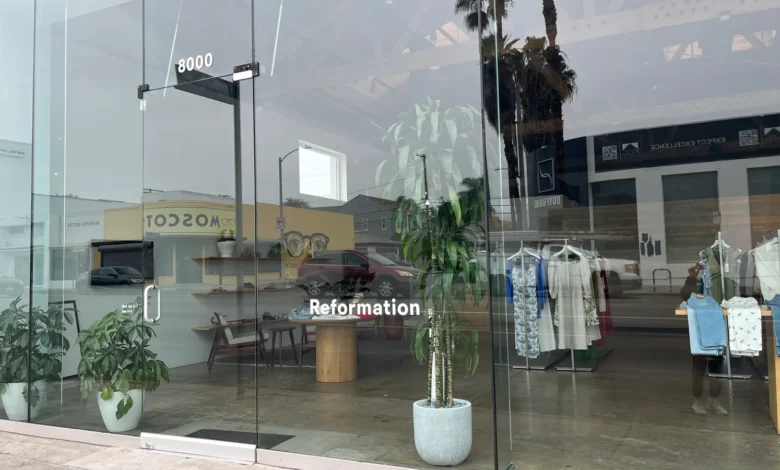
As of the close of the second quarter in 2026, Reformation operated a total of 70 brick-and-mortar locations. These stores, often characterized by airy layouts, vintage decor, and digital integration (such as touchscreens in dressing rooms), serve as experiential touchpoints that deepen consumer loyalty. Building on this momentum, leadership has laid out an aggressive real estate strategy designed to double the size of the store fleet over the next five years.
CFO Joshua Moore provided further clarity on the near-term real estate timeline during the earnings discussion. Moore noted that the company is on track to open nine to 10 new storefronts in the second half of the year alone, bringing the total number of new store openings for full-year 2026 to between 15 and 16 locations. This steady cadence of openings indicates that real estate landlords remain eager to host high-performing DTC brands in premier shopping districts, shopping centers, and lifestyle hubs.
Financial Health and Leadership Outlook
Beyond top-line revenue growth and store count metrics, Reformation’s management team emphasized the overall health of the business during its maiden earnings call. The 24% net revenue jump signals that demand for the brand’s signature dresses, denim, and seasonal collections remains robust across both its e-commerce platforms and physical storefronts.
By maintaining strict control over inventory and leveraging its 60-day-or-less production cycle for over half its goods, the company has insulated itself against many of the inventory gluts that have historically plagued legacy apparel operators. Executives expressed optimism that this disciplined financial execution will continue to drive margin expansion as the store fleet scales.

Broader Market Implications and Future Outlook
Reformation’s strong Q2 earnings report carries broader implications for the broader retail and venture-backed consumer sectors. For months, the window for initial public offerings in consumer discretionary categories had narrowed, with investors demanding immediate profitability and bulletproof unit economics before bidding up share prices.
Reformation’s successful navigation of its post-IPO phase could serve as a bellwether for other mature DTC brands weighing public market debuts. If companies can demonstrate that rapid digital growth can be successfully harmonized with profitable physical retail expansion and sustainable supply chains, investor appetite for consumer IPOs may experience a broader resurgence.
However, challenges remain on the horizon. The primary risk highlighted by market analysts—volatility stemming from short lead times—will require constant vigilance from Reformation’s design and logistics teams. In an industry where geopolitical supply chain disruptions, fluctuating raw material costs, and shifting consumer preferences can alter the retail landscape overnight, the brand’s reactionary model must be managed with absolute precision.
As Reformation presses forward into the second half of 2026, all eyes will be on its upcoming holiday quarter performance. If the company can maintain its current growth trajectory, hit its target of 15 to 16 new store openings, and successfully scale its product categories without diluting its brand equity, it will firmly cement its status as a rare retail success story in the public markets.